
Who we are
A Pan-Asia Coalition
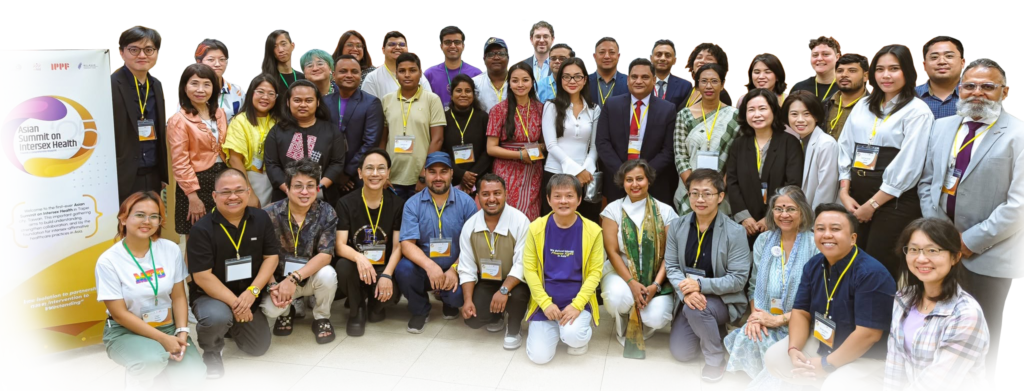
We are a pan-Asian group of medical professionals and intersex human rights advocates, including individuals with lived experience, who convened in Taipei, Taiwan, on 7-8 November 2025, as part of the first-ever Asian Summit on Intersex Healthcare. We hail from India, Nepal, Pakistan, the Philippines, Indonesia, Vietnam, Taiwan, Thailand and Singapore.
In this Consensus Statement, we share the main findings of our two-day intensive workshop regarding the ethical care of intersex people – also referred to as persons with differences of sex development/individuals born with innate variations in sex characteristics/persons with intersex variations.
We affirm that individuals born with innate variations in sex characteristics, many of whom proudly identify as intersex, are a natural part of human diversity. We recognize the profound suffering, injustice, stigma and discrimination caused by and/or reflected in historical and ongoing attempts to “normalize” intersex bodies through the nonconsensual imposition of surgical or hormonal treatments in the absence of medical necessity (see Box 1 for details).
We further acknowledge that such interventions are not rooted in traditional Asian practices but are imported medical models that have, in some cases, overridden longstanding and less pathologizing local approaches to bodily diversity and social integration.
The Principle of Medical Necessity.
For the purposes of this statement, an intervention into a person’s genital, sexual or reproductive anatomy is “medically necessary” if and only if its performance within a given timeframe is necessary to avert a significant threat to the person’s life or otherwise prevent serious harm to the person’s “health-related” well-being.
Given the lack of evidence that non-consensual “normalizing” procedures in early life are necessary or even helpful for preventing psychosocial or mental health-related harms later in life, and may even cause these. A recent international experts report proposes that medical necessity in relation to non-consensual interventions into a person’s body should be determined in relation to physical health, as follows:
- The threat to physical health is both serious and time-sensitive, such that it must be resolved, prior to the possibility of obtaining personal consent, through [the proposed intervention] specifically (i.e., it is not possible to delay the intervention—or to substitute a more conservative alternative—until the individual could consent without putting them at an even greater risk of [serious physical harm]);
- The [intervention, e.g., surgery] is among the least risky, invasive, or harmful of the available treatment options for which there is evidence of comparable effectiveness (i.e., “accounting for all relevant alternatives” […]); and
- The [intervention] is among the options that will preserve, as far as possible (given the other criteria), the individual’s future ability to make any personal, preference-sensitive decisions about their own sexual or reproductive anatomy.[3]
Accordingly, non-consensual interventions that are motivated by sociocultural, aesthetic or gender-normative ideas of how “male” or “female” bodies should look or function are not medically necessary.
Guiding Framework
Core Principles of the Statement
Acknowledging developments within the international human rights framework — including UN Human Rights Council Resolution 55/14 — we commit to a shared, human rights-based, and dignity-affirming foundation for intersex healthcare across Asia.
I. Protecting Bodily Integrity & Autonomy
No Medically Unnecessary Interventions
Medically unnecessary surgical or hormonal interventions, including “normalizing” genital surgeries and sterilization, should be prohibited in non-consenting individuals — including infants or children incapable of providing informed consent, and older individuals who decline to consent.
Written Consent and Supported Decisions
Decisions that can be deferred must be deferred until the individual can give explicit, free, fully informed consent. Parental permission alone cannot substitute this right. Parents should support — not replace — the individual’s decision-making. Privacy and confidentiality must be upheld throughout.
II. Advancing Affirming & Accessible Healthcare
Depathologization and Stigma Reduction
Variations in sex characteristics must be recognized as natural human variation — distinct from sexual orientation or gender identity — and depathologized in medical practice, guidelines, and classifications. Professionals must actively combat stigma using high-quality evidence, including lived experiences.
Multidisciplinary and Holistic Care
Care should be delivered by intersex-affirmative multidisciplinary teams — trauma-informed, gender-affirming, and grounded in dignity, autonomy, and informed choice. Teams may include healthcare providers, intersex community representatives, social workers, mental health professionals, and legal experts.
Essential Support Service
Accessible psychological, psychosocial, and peer support must be available to intersex individuals throughout their life, as well as to their parents and caregivers. These services should be covered by health financing mechanisms to prevent catastrophic payments.
Transparency and Information Access
Intersex individuals and caregivers of intersex minors have the right to full information — up-to-date and comprehensive details about diagnosis, prognosis, treatment risks, and the option not to undergo any interventions.
Medical Education and Accountability
All healthcare providers must receive comprehensive, human rights-based, intersex-affirmative education. Effective accountability mechanisms — including institutional safeguards, multidisciplinary oversight, and professional review — must be in place to prevent medical malpraxis.